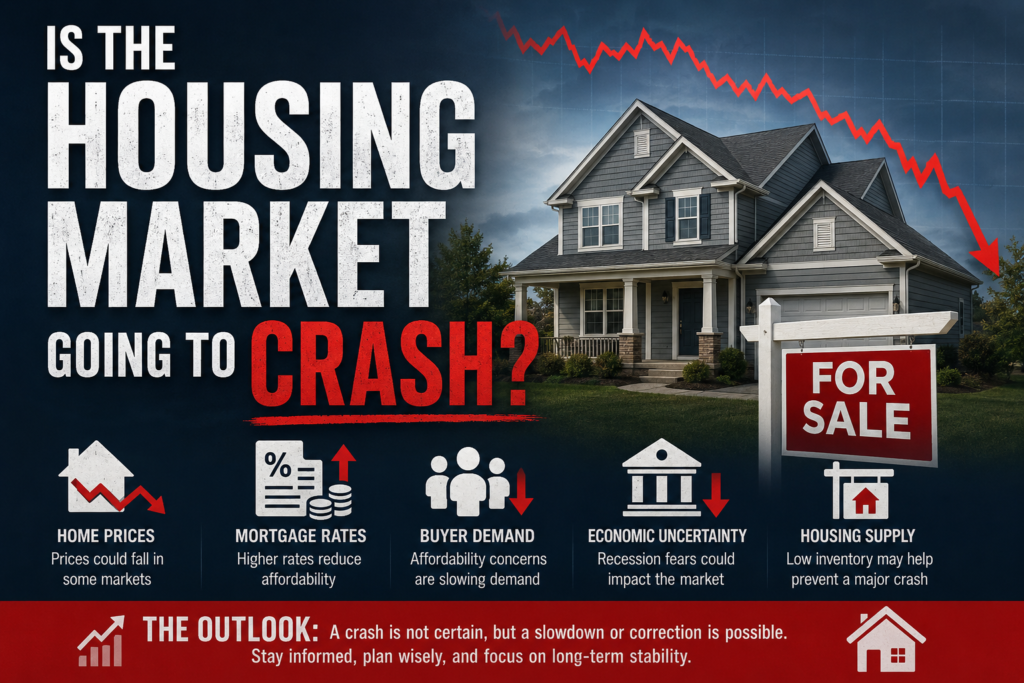
The question “Is the housing market going to crash?” has become one of the most searched financial topics in recent years. Rising home prices, high mortgage rates, inflation concerns, and fears of economic slowdown have caused many buyers and investors to worry about whether the real estate market is heading toward another major collapse like the 2008 housing crisis.
While headlines often predict dramatic changes, the reality of the housing market is far more complex. A crash does not happen overnight, and today’s market conditions are significantly different from those that caused previous real estate collapses. To understand whether the housing market could crash in 2026, it is important to look at the economy, supply and demand, mortgage rates, employment trends, and buyer behavior.
This article explores the key factors influencing the housing market and whether homeowners, buyers, and investors should prepare for a correction, a slowdown, or a full crash.
What Does a Housing Market Crash Mean?
A housing market crash occurs when home prices fall rapidly across large regions or entire countries. Crashes are usually caused by a combination of economic weakness, excessive speculation, high debt levels, and declining buyer demand.
During a crash:
- Home values decline sharply
- Foreclosures increase
- Mortgage defaults rise
- Construction slows down
- Consumer confidence weakens
- Banks tighten lending standards
The most famous example is the 2008 financial crisis, when home prices in many areas fell by 30% to 50%. Millions of people lost homes due to foreclosure, and the global economy entered a severe recession.
However, not every housing slowdown becomes a crash. Sometimes the market simply cools, meaning prices stabilize or decline slightly without widespread financial damage.
Why People Fear a Housing Market Crash in 2026
Several economic conditions have increased concern about the real estate market.
High Mortgage Rates
Mortgage rates have risen significantly compared to the ultra-low rates seen during the pandemic years. Higher borrowing costs reduce affordability for buyers.
For example:
- A buyer who could afford a $500,000 home at low interest rates may now only qualify for a $380,000 or $400,000 home.
- Monthly mortgage payments have increased substantially.
This reduces demand and slows home sales.
Rapid Price Growth
Home prices surged dramatically between 2020 and 2023 in many cities. Some markets experienced double-digit annual growth.
Whenever prices rise too quickly, experts begin asking whether homes are overvalued.
Inflation and Economic Uncertainty
Inflation has affected household budgets worldwide. Consumers are paying more for food, transportation, utilities, and healthcare. Economic uncertainty often causes people to delay major purchases like homes.
Fear of Recession
A recession can hurt the housing market because job losses reduce purchasing power. If unemployment rises sharply, more homeowners may struggle to make mortgage payments.
Why Today’s Housing Market Is Different From 2008
Although concerns exist, many economists argue that the current housing market is fundamentally stronger than the market before the 2008 crash.
Stronger Lending Standards
Before 2008, banks approved risky loans for borrowers with poor credit and little income verification. Many buyers received adjustable-rate mortgages they could not afford long term.
Today, lending rules are much stricter:
- Buyers usually need higher credit scores
- Income verification is required
- Down payment standards are stronger
- Debt-to-income ratios are carefully reviewed
This reduces the likelihood of widespread mortgage defaults.
Limited Housing Supply
One of the biggest differences today is the shortage of homes available for sale.
Many regions still face underbuilding problems that developed over the last decade. Population growth and household formation continue to create demand for housing.
When supply remains low, home prices are less likely to collapse dramatically.
Homeowner Equity Is Much Higher
Most homeowners today have substantial equity because prices increased over recent years.
During the 2008 crisis, many homeowners owed more than their homes were worth. This led people to abandon properties and triggered foreclosure waves.
Now, many homeowners have strong financial positions, which provides market stability.
Fixed Mortgage Rates Protect Homeowners
A large percentage of homeowners locked in historically low fixed mortgage rates during previous years.
Unlike adjustable-rate loans that caused problems in 2008, fixed-rate mortgages provide stable monthly payments. This reduces the risk of sudden financial stress.
Could Home Prices Still Fall?
Even if a full crash does not occur, some markets may experience price declines.
Overheated Cities Are Vulnerable
Cities that saw extreme price growth may face corrections if affordability becomes too difficult.
Luxury markets and speculative investment areas are often more vulnerable to downturns.
Regional Differences Matter
Housing markets are local. One city may experience falling prices while another continues growing.
Factors that influence local housing strength include:
- Job growth
- Population trends
- New construction
- Local wages
- Migration patterns
- Interest rates
For example, cities with strong technology, healthcare, or manufacturing industries may remain stable even during broader economic slowdowns.
Affordability Pressure
In many areas, wages have not kept pace with home prices.
If buyers cannot afford homes, sellers may eventually need to lower asking prices to attract offers.
What Experts Are Predicting
Most housing analysts do not currently expect a nationwide crash similar to 2008. Instead, many predict slower growth or moderate corrections.
Soft Landing Scenario
A “soft landing” occurs when the market cools gradually without major economic damage.
In this situation:
- Home prices level off
- Sales activity slows
- Mortgage rates stabilize
- Inventory increases slightly
- Buyers regain negotiating power
This is considered the most likely outcome by many economists.
Mild Correction Scenario
Some experts believe certain markets could see declines of 5% to 15%, especially where prices rose too quickly.
This would not necessarily qualify as a crash but rather a normalization of values.
Severe Crash Scenario
A severe crash could still happen if several negative events occur simultaneously, such as:
- Major recession
- Massive unemployment
- Banking crisis
- Sharp increase in foreclosures
- Financial market instability
While possible, most analysts currently consider this less likely due to stronger lending practices and limited inventory.
The Role of Mortgage Rates
Mortgage rates remain one of the most important factors affecting the housing market.
Higher Rates Reduce Buyer Demand
When rates increase:
- Monthly payments rise
- Buyers qualify for smaller loans
- Home affordability declines
- Sales activity slows
This can put downward pressure on prices.
Lower Rates Could Reignite Competition
If inflation cools and central banks lower interest rates, mortgage rates could decline.
Lower rates may:
- Increase buyer activity
- Boost home prices again
- Intensify competition in desirable markets
The future direction of rates will significantly shape the housing market over the next few years.
Is It a Good Time to Buy a House?
The answer depends on personal finances, long-term goals, and local market conditions.
Buying May Make Sense If:
- You plan to stay long term
- You have stable income
- You can comfortably afford payments
- You found a suitable property
- You have sufficient savings
Real estate is often most successful as a long-term investment rather than a short-term speculation.
Waiting May Make Sense If:
- You expect local prices to decline
- Mortgage rates are too high for your budget
- Your employment situation is uncertain
- You need flexibility
There is no universally perfect time to buy because market conditions vary widely.
What Sellers Should Know
Home sellers may face different conditions than during the pandemic housing boom.
Homes May Take Longer to Sell
Buyers are becoming more cautious due to affordability concerns.
Sellers may need to:
- Price homes realistically
- Offer incentives
- Accept negotiations
- Improve property presentation
Overpricing Can Hurt Sales
In slower markets, overpriced homes often remain unsold for long periods.
Competitive pricing is increasingly important.
Real Estate Investors and Market Risk
Investors are also watching the housing market carefully.
Rental Demand Remains Strong
High mortgage rates have pushed many people toward renting instead of buying.
This supports rental property demand in many cities.
Short-Term Speculation Is Riskier
Investors hoping for rapid appreciation may face challenges if price growth slows.
Cash flow and long-term fundamentals are becoming more important than quick profits.
Global Economic Factors Affecting Housing
The housing market does not operate independently. Several global factors can influence real estate performance.
Inflation
Persistent inflation keeps borrowing costs elevated and reduces consumer purchasing power.
Employment
Strong labor markets help support housing demand because employed workers are more likely to buy homes.
Population Growth
Areas experiencing migration and population growth tend to maintain stronger housing demand.
Government Policy
Governments and central banks influence real estate through:
- Interest rates
- Tax policies
- Housing regulations
- Construction incentives
Policy changes can dramatically affect market conditions.
Signs to Watch for in the Future
People concerned about a housing crash should monitor key indicators.
Rising Foreclosures
Large increases in foreclosures may indicate growing financial stress.
Increasing Inventory
If unsold homes rise rapidly, it could weaken prices.
Falling Sales Activity
Sharp declines in transactions can signal weakening demand.
Employment Weakness
Job losses often affect housing markets significantly.
Mortgage Delinquencies
Higher delinquency rates may suggest homeowners are struggling financially.
Conclusion
So, is the housing market going to crash?
At the moment, most evidence suggests that a nationwide crash similar to 2008 is unlikely, though certain regions may experience corrections or slower growth. Today’s market benefits from stronger lending standards, limited housing supply, higher homeowner equity, and more stable mortgage structures.
However, the housing market still faces real challenges. High mortgage rates, affordability concerns, inflation, and economic uncertainty are reducing buyer activity and slowing price growth in many areas.
Rather than expecting a dramatic collapse, many experts believe the market is transitioning into a more balanced phase where buyers and sellers must adjust to changing economic realities.
For homeowners, buyers, and investors, the best approach is to focus on long-term financial stability rather than short-term market predictions. Real estate markets naturally move through cycles, and careful planning remains more important than trying to perfectly time the market.