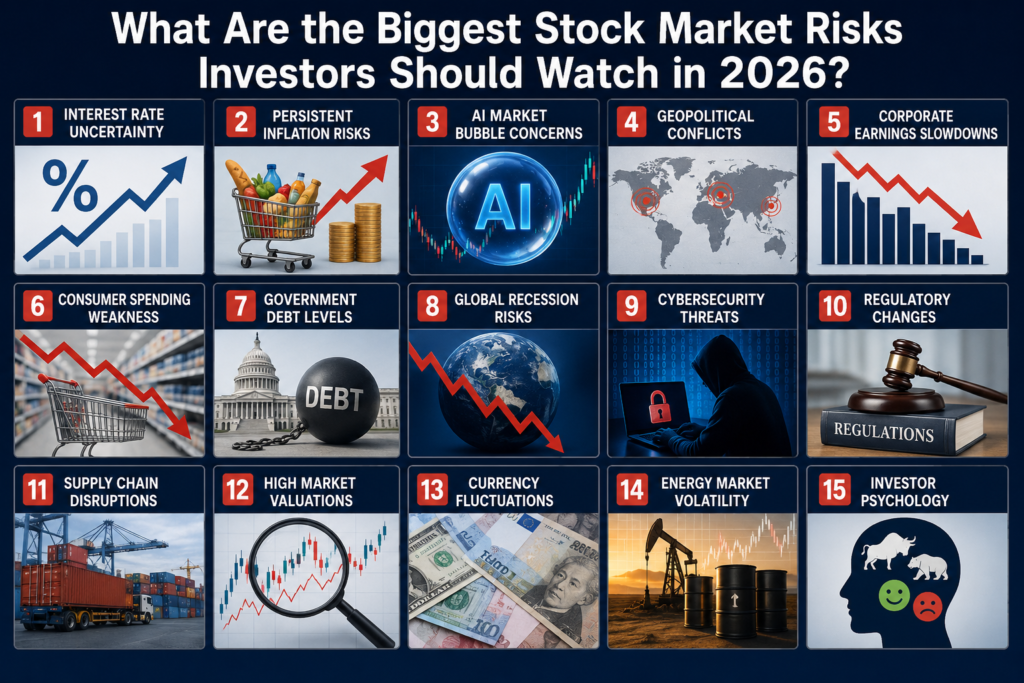
Introduction
The stock market entered 2026 with cautious optimism, supported by technological innovation, resilient corporate earnings, and continued investment in artificial intelligence (AI), renewable energy, and digital infrastructure. However, investors also face an increasingly complex landscape shaped by economic uncertainty, geopolitical tensions, changing monetary policies, and rapidly evolving technologies.
While market opportunities remain abundant, understanding the risks is just as important as identifying growth potential. Successful investing isn’t about avoiding risk entirely—it’s about recognizing potential threats early and positioning a portfolio to withstand periods of volatility.
This guide explores the biggest stock market risks investors should monitor throughout 2026 and offers practical strategies to manage uncertainty while staying focused on long-term financial goals.
1. Interest Rate Uncertainty
Interest rates remain one of the most influential drivers of stock market performance.
Although inflation has moderated compared to previous years, central banks continue balancing economic growth against inflation risks. Any unexpected changes in interest rate policy could significantly impact financial markets.
Higher interest rates often lead to:
- Lower corporate borrowing
- Reduced consumer spending
- Pressure on growth stocks
- Higher bond yields competing with equities
Technology companies, which often rely on future earnings expectations, typically experience greater volatility when interest rates rise unexpectedly.
Investors should closely monitor central bank announcements and inflation reports throughout 2026.
2. Persistent Inflation Risks
Inflation remains a concern even if headline numbers appear stable.
Several factors could reignite price pressures:
- Energy supply disruptions
- Rising labor costs
- Housing shortages
- Global shipping constraints
- Commodity price spikes
If inflation accelerates again, companies may face shrinking profit margins as operating costs increase.
Businesses with strong pricing power generally perform better during inflationary periods because they can pass higher costs on to consumers.
Investors should pay close attention to sectors that historically perform well during inflation, including:
- Utilities
- Energy
- Consumer staples
- Healthcare
3. AI Market Bubble Concerns
Artificial intelligence continues to dominate investment discussions.
Many AI-related companies have experienced extraordinary stock appreciation over the past several years. While AI offers enormous long-term potential, excessive valuations could create bubble-like conditions.
Warning signs include:
- Extremely high price-to-earnings ratios
- Speculative investments without profits
- Excessive retail enthusiasm
- Unrealistic growth expectations
History has shown that innovative technologies often experience periods of overvaluation before stabilizing.
Investors should separate companies generating real AI revenue from those simply benefiting from market hype.
4. Geopolitical Conflicts
Global political instability continues influencing financial markets.
Potential risks include:
- International trade disputes
- Military conflicts
- Cyber warfare
- Economic sanctions
- Election uncertainty
Geopolitical events often trigger sudden market declines, increased volatility, and shifts in commodity prices.
Diversification across countries and industries helps reduce exposure to region-specific risks.
5. Corporate Earnings Slowdowns
Stock prices ultimately depend on corporate profitability.
If companies begin reporting weaker earnings due to slowing consumer demand or rising expenses, broader markets could face significant pressure.
Investors should monitor:
- Revenue growth
- Profit margins
- Earnings guidance
- Cost management
- Consumer demand
Quarterly earnings seasons often create heightened volatility across major market indexes.
6. Consumer Spending Weakness
Consumer spending drives a large portion of economic activity.
If households reduce spending due to:
- High debt levels
- Rising unemployment
- Inflation
- Lower savings
many industries may experience slower growth.
Retail, travel, hospitality, luxury goods, and discretionary products are particularly sensitive to declining consumer confidence.
Monitoring consumer confidence indexes can provide early warning signs.
7. Government Debt Levels
Many governments continue operating with historically high debt burdens.
Large fiscal deficits may create concerns about:
- Future tax increases
- Reduced public spending
- Higher bond yields
- Currency fluctuations
Government debt itself does not automatically trigger market declines, but changing fiscal policies can influence investor sentiment.
8. Global Recession Risks
Although economists remain divided on recession forecasts, global economic slowdowns remain possible.
Factors contributing to recession risks include:
- Weak manufacturing
- Slower international trade
- Declining business investment
- Tight lending conditions
Certain industries typically experience larger declines during recessions, including:
- Consumer discretionary
- Financials
- Industrials
- Real estate
Defensive sectors often outperform during economic downturns.
9. Cybersecurity Threats
Cybersecurity has become a financial market issue rather than just an IT concern.
Large-scale cyberattacks targeting:
- Financial institutions
- Cloud providers
- Payment networks
- Critical infrastructure
could temporarily disrupt markets and negatively impact company valuations.
Companies investing heavily in cybersecurity may become increasingly attractive long-term investments.
10. Regulatory Changes
Governments worldwide continue introducing new regulations affecting:
- Artificial intelligence
- Big technology companies
- Data privacy
- Cryptocurrency
- Environmental standards
Regulatory actions can significantly impact individual sectors almost overnight.
Investors should stay informed about proposed legislation affecting industries within their portfolios.
11. Supply Chain Disruptions
Although supply chains have improved compared to previous years, global logistics remain vulnerable.
Potential disruptions include:
- Natural disasters
- Port congestion
- Labor strikes
- Political conflicts
- Transportation shortages
Manufacturers dependent on international suppliers may face increased costs and delayed production.
Companies with diversified supply chains generally demonstrate greater resilience.
12. High Market Valuations
One concern entering 2026 is elevated market valuations.
When stock prices rise faster than corporate earnings, markets become increasingly sensitive to negative surprises.
Metrics worth monitoring include:
- Price-to-earnings ratios
- Price-to-sales ratios
- Market capitalization relative to GDP
- Earnings growth
High valuations don’t necessarily predict immediate corrections, but they reduce the margin of safety for investors.
13. Currency Fluctuations
Global investors should also consider currency risk.
Exchange rate movements affect multinational companies through:
- Overseas earnings
- Import costs
- Export competitiveness
- Foreign investments
Strong currency swings can influence both company profits and international portfolio performance.
14. Energy Market Volatility
Energy prices continue affecting inflation, transportation costs, manufacturing, and consumer spending.
Oil and natural gas markets remain vulnerable to:
- Production cuts
- Weather events
- Geopolitical conflicts
- Supply shortages
Rapid increases in energy prices often pressure both businesses and consumers.
Energy sector investments can sometimes provide a hedge against rising commodity prices.
15. Investor Psychology
One of the most overlooked risks is emotional investing.
Market history repeatedly demonstrates that fear and greed often drive short-term price movements.
Common behavioral mistakes include:
- Panic selling
- Chasing market rallies
- Overtrading
- Ignoring diversification
- Following social media hype
Maintaining a disciplined investment strategy helps reduce costly emotional decisions.
How Investors Can Reduce Risk in 2026
While risks cannot be eliminated entirely, investors can improve portfolio resilience through several practical strategies.
Diversify Across Asset Classes
Holding investments across:
- Stocks
- Bonds
- Cash
- International markets
- Real assets
helps reduce concentration risk.
Focus on Quality Companies
Companies with:
- Strong balance sheets
- Consistent earnings
- Competitive advantages
- Healthy cash flow
often perform better during periods of market uncertainty.
Invest for the Long Term
Short-term volatility is a normal part of investing.
Long-term investors who remain disciplined generally benefit from market recoveries over time.
Avoid making investment decisions based solely on daily market headlines.
Rebalance Regularly
Periodic portfolio rebalancing helps maintain your intended risk level.
Selling portions of outperforming assets while adding to underweighted investments keeps diversification intact.
Maintain an Emergency Fund
Having sufficient cash reserves reduces the need to sell investments during market downturns.
Financial flexibility allows investors to remain patient during periods of volatility.
Sectors to Watch in 2026
Some industries may face greater risks, while others could demonstrate resilience.
Higher-Risk Areas
- Highly valued AI startups
- Speculative technology companies
- Commercial real estate
- Small-cap growth stocks
- Consumer discretionary businesses
Potentially Defensive Areas
- Healthcare
- Utilities
- Consumer staples
- Infrastructure
- Cybersecurity
- Dividend-paying companies
Sector performance will largely depend on economic growth, inflation trends, and interest rate policies.
Final Thoughts
The stock market in 2026 presents both exciting opportunities and meaningful challenges. Investors must navigate interest rate uncertainty, inflation risks, geopolitical instability, AI-driven valuations, cybersecurity concerns, and evolving government regulations while maintaining a disciplined investment strategy.
Rather than attempting to predict every market movement, successful investors focus on diversification, quality businesses, risk management, and long-term financial objectives. Market corrections and periods of volatility are inevitable, but they also create opportunities for patient investors with well-constructed portfolios.
By staying informed, avoiding emotional decision-making, and regularly reviewing investment strategies, investors can better position themselves to manage the biggest stock market risks of 2026 while pursuing sustainable long-term growth.