Introduction
Phone scams have become one of the most common forms of cybercrime in the digital age. From fake bank representatives and fraudulent tech-support calls to voice-cloning scams and phishing attempts, criminals are constantly finding new ways to deceive people over the phone. As smartphone usage continues to grow worldwide, the financial and emotional impact of these scams has reached unprecedented levels.
Fortunately, artificial intelligence (AI) is emerging as one of the most effective tools in the fight against phone fraud. AI-powered scam protection systems can analyze calls, identify suspicious behavior, detect fraudulent patterns, and warn users before they become victims. Mobile carriers, smartphone manufacturers, cybersecurity companies, and app developers are increasingly integrating AI technologies into their products to provide stronger protection against evolving threats.
This article explores how AI phone scam protection works, its key benefits, current applications, challenges, and what the future holds for AI-driven mobile security.
The Growing Threat of Phone Scams
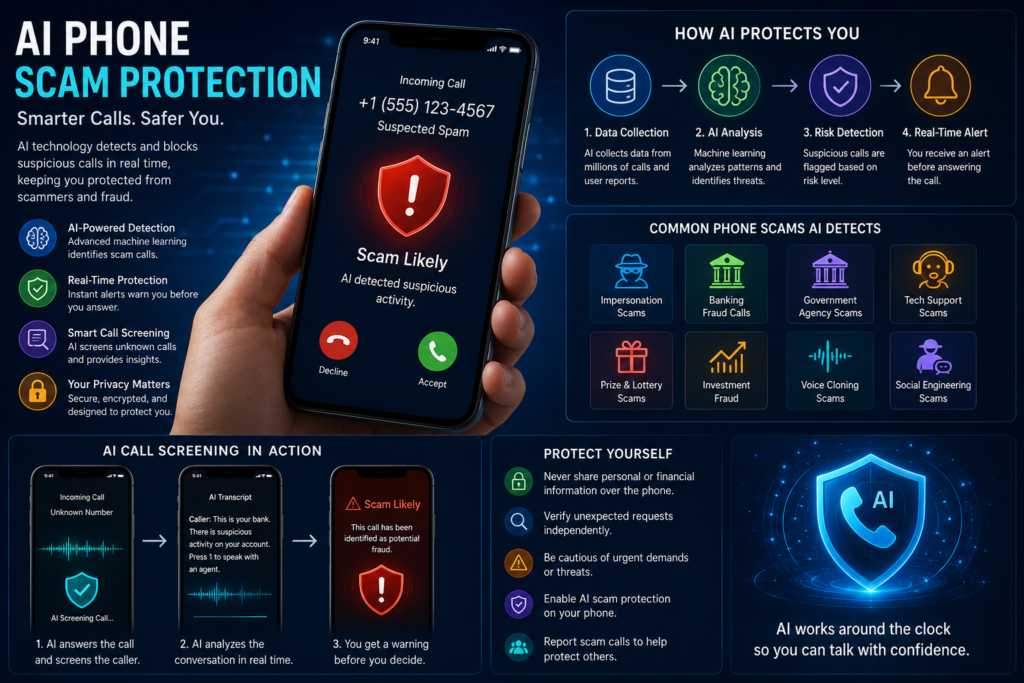
Phone scams are no longer limited to simple robocalls. Modern scammers use sophisticated techniques designed to exploit trust and urgency. Common scam types include:
- Impersonation scams
- Banking fraud calls
- Government agency scams
- Technical support scams
- Lottery and prize scams
- Investment fraud schemes
- Voice-cloning attacks
- Social engineering scams
According to cybersecurity reports worldwide, billions of scam calls are made every year. These fraudulent calls target individuals, businesses, and organizations, resulting in billions of dollars in losses.
Traditional call-blocking methods often struggle because scammers constantly change phone numbers and tactics. This is where AI introduces a significant advantage.
What Is AI Phone Scam Protection?
AI phone scam protection refers to the use of artificial intelligence and machine learning technologies to detect, analyze, and prevent fraudulent phone calls.
Instead of relying solely on static blacklists, AI systems learn from massive datasets of phone activity. They recognize patterns associated with scam behavior and can make real-time decisions about whether a call is likely to be legitimate or fraudulent.
AI-powered systems evaluate factors such as:
- Call frequency
- Caller reputation
- Calling patterns
- Speech characteristics
- Voice behavior
- Historical scam databases
- User reports
- Network activity
By analyzing these variables simultaneously, AI can identify suspicious calls with remarkable accuracy.
How AI Detects Scam Calls
1. Pattern Recognition
Machine learning algorithms are trained using millions of call records. These systems learn the characteristics commonly associated with scam operations.
For example, AI may detect:
- Thousands of calls originating from a single source
- Calls placed at unusual intervals
- High rates of unanswered calls
- Short-duration mass dialing campaigns
Such patterns often indicate robocall or scam activity.
2. Voice Analysis
Advanced AI can analyze speech patterns during conversations.
The technology examines:
- Tone of voice
- Speech speed
- Language usage
- Emotional manipulation tactics
- Scripted responses
When suspicious behaviors are detected, users may receive warnings while the call is in progress.
3. Caller Identity Verification
AI systems compare caller information against trusted databases.
If a caller claims to represent a bank, government agency, or company, AI can verify whether the phone number matches legitimate records.
If discrepancies exist, the user receives an alert indicating potential fraud.
4. Behavioral Analysis
Scammers often follow predictable behavioral patterns.
Examples include:
- Demanding immediate payment
- Requesting personal information
- Creating urgency
- Threatening legal action
- Offering unrealistic rewards
AI models recognize these behaviors and classify calls accordingly.
AI-Powered Call Screening
One of the most popular applications of AI phone scam protection is intelligent call screening.
Instead of simply blocking unknown numbers, AI assistants answer suspicious calls on behalf of users.
The AI can:
- Ask callers to identify themselves
- Determine the purpose of the call
- Analyze responses
- Transcribe conversations
- Decide whether to connect the call
This reduces interruptions while protecting users from potential scams.
Many smartphone platforms now offer AI-based call screening features that provide real-time insights into incoming calls.
Real-Time Scam Warnings
Modern AI systems can provide instant warnings during phone conversations.
For example, if the AI detects suspicious phrases such as:
- “Your account will be suspended”
- “You must act immediately”
- “Provide your banking information”
- “Pay using gift cards”
The device can display alerts warning users of possible fraud.
These real-time notifications help users make informed decisions before sharing sensitive information.
Protection Against Voice-Cloning Scams
One of the newest threats in cybersecurity involves AI-generated voice cloning.
Criminals can create realistic synthetic voices that imitate family members, friends, executives, or public figures. Victims may receive calls appearing to come from trusted individuals requesting money or sensitive information.
Ironically, AI is also becoming the solution to this problem.
AI-based detection systems can identify subtle indicators of synthetic speech, including:
- Audio inconsistencies
- Digital artifacts
- Unnatural speech rhythms
- Machine-generated vocal signatures
As voice-cloning technology advances, AI detection tools will play an increasingly important role in protecting users.
AI and Mobile Carrier Protection
Telecommunication providers are investing heavily in AI-based scam prevention.
AI helps carriers:
- Detect fraudulent networks
- Identify robocall campaigns
- Monitor unusual traffic patterns
- Block suspicious calls before delivery
- Analyze customer reports
Instead of reacting after scams occur, carriers can proactively disrupt fraudulent operations at the network level.
This large-scale protection benefits millions of users simultaneously.
Benefits of AI Phone Scam Protection
Enhanced Accuracy
Traditional spam filters rely on known phone numbers. AI goes beyond static lists by recognizing scam behaviors even when numbers change.
Faster Detection
AI systems can evaluate calls within milliseconds, enabling real-time protection.
Continuous Learning
Machine learning models improve over time as they process more data and user feedback.
Reduced False Positives
Advanced AI can better distinguish between legitimate business calls and fraudulent activity.
Personalized Security
AI adapts to individual calling habits, improving protection based on user behavior.
Challenges Facing AI Scam Detection
Although AI offers significant advantages, it is not perfect.
Evolving Scam Tactics
Cybercriminals continuously adapt their methods to avoid detection. AI systems must be regularly updated to remain effective.
Privacy Concerns
Some users worry about AI analyzing conversations and call data.
Developers must ensure:
- Strong encryption
- Data protection measures
- Transparent privacy policies
- Responsible AI usage
False Alerts
Occasionally, legitimate calls may be flagged as suspicious. Balancing security and convenience remains an ongoing challenge.
International Scam Operations
Scammers often operate across multiple countries and telecommunications systems, making enforcement more difficult.
AI Scam Protection Apps
Many security applications now incorporate AI technology to combat phone scams.
Features often include:
- Caller identification
- Spam call blocking
- Fraud detection
- Real-time warnings
- SMS scam protection
- Community reporting systems
As machine learning algorithms become more advanced, these apps continue improving their detection capabilities.
The Role of Generative AI
Generative AI is transforming both sides of the cybersecurity landscape.
While scammers use AI to create convincing messages, synthetic voices, and automated conversations, defenders use AI to:
- Detect fraud patterns
- Analyze suspicious communications
- Generate security insights
- Improve threat intelligence
This ongoing technological competition will shape the future of phone scam prevention.
Future Trends in AI Phone Scam Protection
Several innovations are expected to strengthen mobile security in the coming years.
Voice Authentication
Future smartphones may use biometric voice verification to confirm caller identities.
On-Device AI Processing
More scam detection capabilities will operate directly on smartphones, improving privacy and speed.
Cross-Platform Threat Sharing
Security providers, telecom companies, and device manufacturers may share threat intelligence in real time.
Advanced Deepfake Detection
AI systems will become increasingly capable of identifying synthetic voices and manipulated audio.
Predictive Fraud Prevention
Future AI may predict scam campaigns before they reach large numbers of potential victims.
Tips for Staying Safe
Even with advanced AI protection, users should remain cautious.
Best practices include:
- Never share passwords over the phone.
- Verify unexpected requests independently.
- Be skeptical of urgent payment demands.
- Avoid clicking suspicious links sent via SMS.
- Enable scam protection features on your device.
- Report fraudulent calls to your carrier.
- Keep software and security apps updated.
Human awareness remains an essential component of cybersecurity.
Conclusion
AI phone scam protection is rapidly becoming one of the most important defenses against modern telecommunications fraud. By combining machine learning, voice analysis, behavioral detection, and real-time threat intelligence, AI systems can identify and block scams more effectively than traditional methods.
As phone scams become more sophisticated, particularly with the rise of voice cloning and generative AI, intelligent security solutions will be critical for protecting consumers and businesses alike. While no technology can eliminate fraud entirely, AI significantly reduces risk and empowers users to recognize threats before becoming victims.
The future of mobile security will depend heavily on artificial intelligence, making AI phone scam protection a cornerstone of safer digital communication in the years ahead.