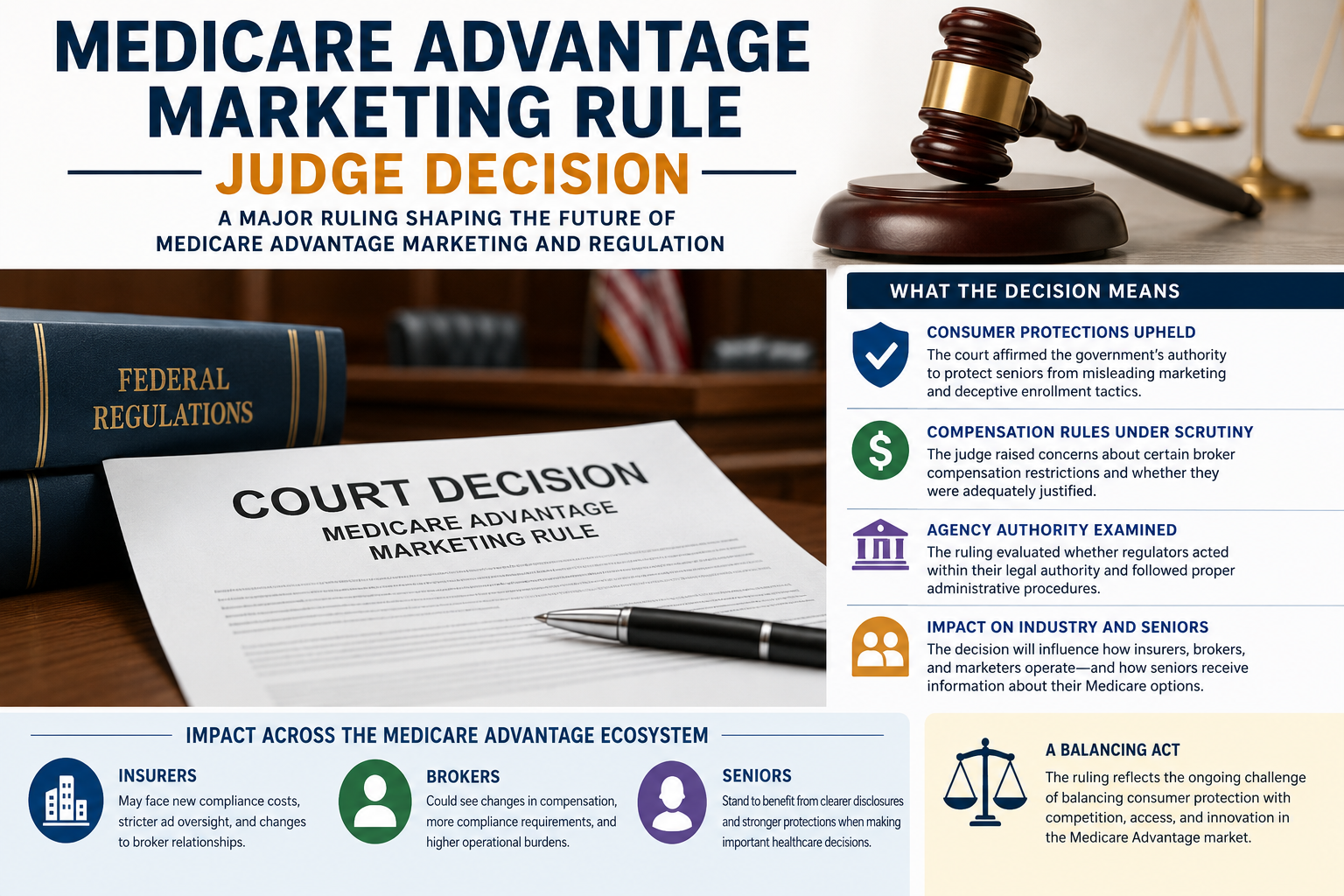
The ongoing legal debate surrounding Medicare Advantage marketing regulations has become one of the most closely watched healthcare policy issues in the United States. A recent judge’s decision involving the Medicare Advantage marketing rule has intensified discussions about advertising transparency, broker compensation, consumer protections, and the role of private insurers in the Medicare system.
The ruling has implications for insurance companies, healthcare marketers, agents, brokers, and millions of seniors who rely on Medicare Advantage plans for healthcare coverage. Understanding the background of the case, the judge’s reasoning, and the broader industry impact is essential for anyone following healthcare regulation in America.
Understanding Medicare Advantage
Before examining the legal decision, it helps to understand what Medicare Advantage is and why marketing rules matter.
Centers for Medicare & Medicaid Services administers Medicare, the federal health insurance program primarily for people aged 65 and older. Medicare Advantage, also known as Medicare Part C, allows private insurance companies to provide Medicare benefits through approved plans.
These plans often include additional benefits such as:
- Dental coverage
- Vision care
- Prescription drug plans
- Fitness memberships
- Hearing services
Because private insurers compete for beneficiaries, aggressive marketing has become a major feature of the Medicare Advantage industry.
Television commercials, online advertisements, celebrity endorsements, mailers, and broker outreach campaigns are all common marketing tools used to attract seniors during enrollment periods.
Why Marketing Rules Became a Major Issue
Over the years, regulators received increasing complaints about misleading advertising practices tied to Medicare Advantage plans. Some advertisements allegedly:
- Confused consumers about plan availability
- Suggested benefits that were not universally accessible
- Used deceptive language implying government endorsement
- Failed to clearly explain provider restrictions
- Pressured seniors into switching plans unnecessarily
Federal regulators argued that stronger oversight was needed to protect vulnerable consumers from deceptive marketing practices.
In response, the Centers for Medicare & Medicaid Services introduced updated marketing regulations aimed at increasing transparency and accountability across the Medicare Advantage marketplace.
The Medicare Advantage Marketing Rule
The revised marketing rule included several controversial provisions designed to regulate how insurers and brokers advertise Medicare Advantage plans.
Some key elements included:
Stricter Advertising Oversight
Insurance companies and third-party marketers were required to ensure that advertisements accurately represented available benefits and coverage limitations.
Call Recording Requirements
Certain broker and customer service calls involving Medicare Advantage sales had to be recorded and retained for compliance review.
Limitations on Lead Generation
The rules sought to restrict practices where consumer information gathered for one purpose was used to market unrelated plans without clear consent.
Broker Compensation Regulations
One of the most controversial aspects involved limits on compensation structures for insurance agents and brokers.
Regulators argued that certain payment arrangements encouraged agents to prioritize commissions over beneficiaries’ best interests.
Disclaimer Requirements
Advertisements needed to clearly explain that plan availability and benefits vary by location and eligibility.
Industry Pushback Against the Rule
Several industry groups challenged portions of the new regulations in court. Plaintiffs included insurance trade organizations, broker associations, and companies involved in Medicare Advantage marketing.
Critics argued that the rules:
- Exceeded regulatory authority
- Imposed excessive compliance burdens
- Restricted legitimate business operations
- Increased administrative costs
- Reduced consumer access to information
- Harmed independent insurance brokers
Some groups also claimed that the compensation limits would disproportionately affect smaller agencies and independent brokers who rely heavily on Medicare Advantage enrollment commissions.
The legal challenge eventually reached federal court, where a judge was asked to determine whether the government acted within its authority.
The Judge’s Decision Explained
The judge’s decision on the Medicare Advantage marketing rule became a major development for the healthcare and insurance sectors.
While the exact details of the ruling varied depending on specific provisions under review, the court generally examined whether federal regulators had the legal authority to impose the disputed marketing restrictions.
The judge evaluated several critical questions:
- Did the Centers for Medicare & Medicaid Services exceed its statutory authority?
- Were the regulations properly justified?
- Did the agency follow appropriate administrative procedures?
- Were the rules arbitrary or capricious under federal administrative law?
The court’s ruling addressed these questions while balancing consumer protection concerns against industry objections.
Key Findings From the Court
Partial Support for Regulators
In several areas, the judge appeared to support the government’s authority to regulate Medicare Advantage marketing practices.
The court acknowledged that federal agencies have a legitimate interest in protecting seniors from misleading advertising and deceptive enrollment tactics.
This recognition reinforced CMS’s role in overseeing Medicare-related communications.
Concerns About Compensation Restrictions
One of the most heavily debated issues involved broker compensation limitations.
The judge reportedly scrutinized whether CMS had adequately justified certain restrictions affecting agent payments and administrative fees.
Industry groups argued that compensation changes could reduce access to licensed advisors who help seniors navigate complex Medicare choices.
Some portions of the compensation-related rules faced increased judicial skepticism.
Administrative Procedure Questions
The ruling also examined whether regulators properly explained the reasoning behind the rules during the rulemaking process.
Under federal administrative law, agencies must provide rational explanations for major policy changes.
Courts often review whether agencies considered economic impacts, public comments, and alternative approaches before finalizing regulations.
Why the Decision Matters
The Medicare Advantage marketing rule judge decision has far-reaching consequences beyond the immediate legal dispute.
Impact on Insurance Companies
Large insurers offering Medicare Advantage plans may need to adjust compliance systems, advertising practices, and broker relationships depending on the final legal outcome.
Companies could face:
- Increased compliance expenses
- Revised marketing approval procedures
- Enhanced oversight requirements
- Changes in broker contracting strategies
Major insurers involved in Medicare Advantage include:
- UnitedHealth Group
- Humana
- CVS Health
- Elevance Health
Impact on Insurance Brokers
Independent brokers play a major role in helping seniors compare Medicare plans.
If compensation restrictions remain in place, brokers may experience:
- Lower revenue opportunities
- Increased administrative obligations
- Higher compliance risks
- More documentation requirements
Some broker organizations warn that smaller agencies could struggle to survive under stricter regulatory standards.
Impact on Seniors
For Medicare beneficiaries, the decision could shape how healthcare information is presented in the future.
Potential consumer benefits include:
- Clearer advertising disclosures
- Reduced deceptive marketing
- Better transparency about plan limitations
- Improved enrollment protections
However, critics argue that overly restrictive rules might also reduce access to personalized guidance from brokers and agents.
Broader Political and Regulatory Implications
The Medicare Advantage marketing dispute also reflects larger political tensions over healthcare regulation in the United States.
Supporters of stronger oversight argue that Medicare Advantage has become too commercialized, with excessive marketing spending and aggressive enrollment tactics.
Opponents contend that heavy-handed regulation could stifle competition and reduce innovation within the private Medicare market.
The case highlights ongoing debates about:
- Federal regulatory power
- Consumer protection standards
- Private-sector participation in public healthcare programs
- Administrative agency authority
The ruling may also influence future healthcare policy decisions involving advertising standards and insurance oversight.
Potential Future Legal Developments
The judge’s decision may not represent the final chapter in the Medicare Advantage marketing rule dispute.
Possible next steps include:
Appeals
Either side could appeal portions of the ruling to a higher federal court.
Appeals could further clarify the extent of CMS’s authority over Medicare Advantage marketing practices.
Regulatory Revisions
Federal regulators may revise certain provisions in response to judicial concerns.
Agencies often modify rules after court decisions to strengthen legal justification or address procedural deficiencies.
Additional Industry Challenges
Future legal challenges could emerge if insurers or brokers believe new regulations remain overly burdensome.
Healthcare regulation is frequently subject to ongoing litigation due to the enormous financial stakes involved.
The Growing Importance of Medicare Advantage
The legal battle surrounding marketing regulations reflects the growing importance of Medicare Advantage within the American healthcare system.
Enrollment in Medicare Advantage plans has steadily increased over the past decade, with millions of seniors choosing private plans over traditional Medicare.
This growth has intensified competition among insurers, leading to larger advertising budgets and more sophisticated marketing campaigns.
As Medicare Advantage continues expanding, regulatory scrutiny is likely to remain strong.
Balancing Consumer Protection and Market Competition
At the center of the judge’s decision is a difficult balancing act.
Regulators want to protect seniors from misleading or confusing marketing tactics. At the same time, insurers and brokers argue that consumers benefit from competition and access to information about plan choices.
The challenge for policymakers is finding a middle ground that:
- Encourages fair competition
- Maintains transparency
- Protects vulnerable consumers
- Preserves access to professional guidance
The court’s ruling represents an important step in defining where that balance should exist.
Conclusion
The Medicare Advantage marketing rule judge decision marks a significant moment in healthcare regulation and insurance law. The case underscores the increasing scrutiny facing Medicare Advantage advertising practices as enrollment in private Medicare plans continues to grow.
While regulators seek stronger consumer protections, insurers and brokers remain concerned about regulatory overreach and operational burdens. The judge’s ruling attempts to navigate these competing interests while interpreting the limits of federal agency authority.
For seniors, the outcome could influence how Medicare information is presented and how easily they can access reliable guidance during enrollment decisions. For the insurance industry, the decision may reshape marketing strategies, broker compensation structures, and compliance requirements for years to come.
As additional legal and regulatory developments unfold, the Medicare Advantage marketing debate will likely remain a major issue within the broader conversation about healthcare policy, consumer rights, and government oversight in the United States.