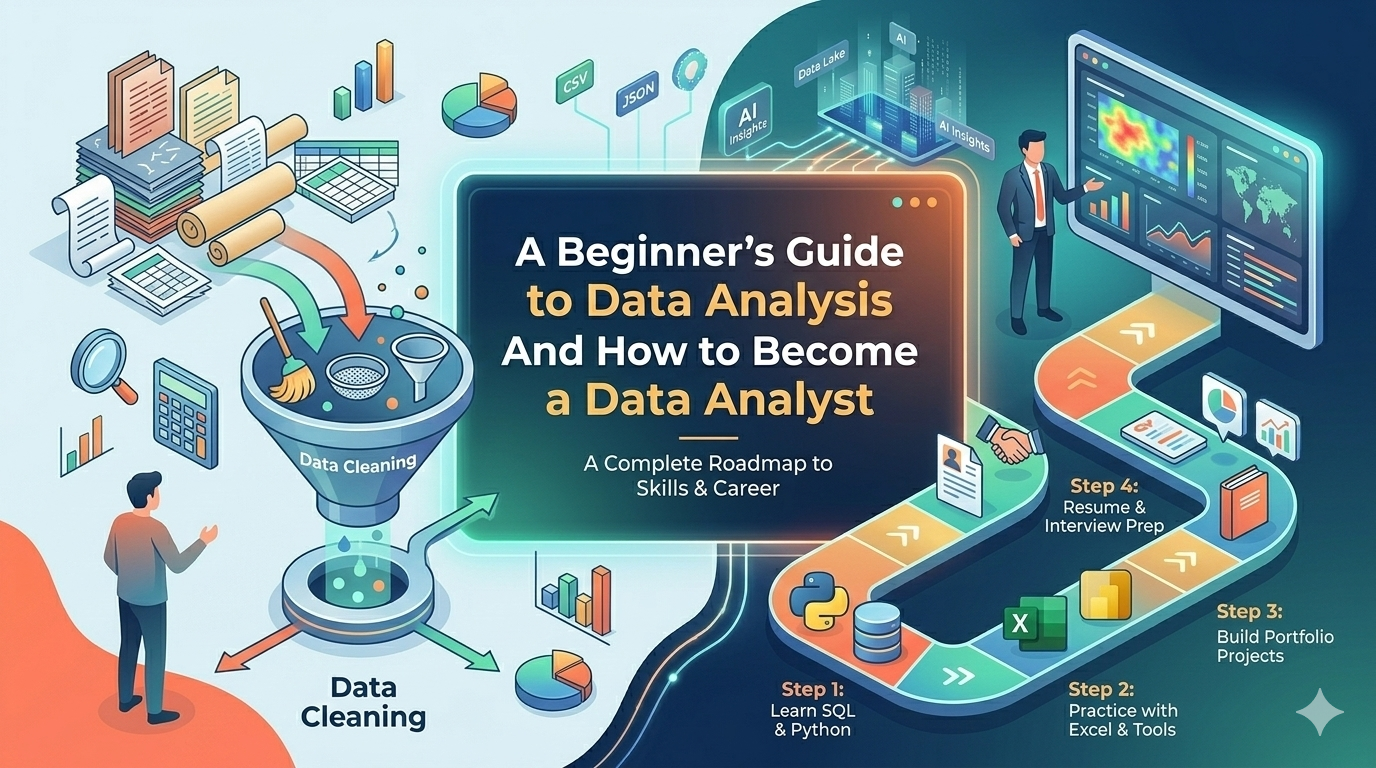
Introduction
Learning how to become a data analyst with no experience can feel challenging when most job advertisements ask for technical skills or previous work experience. However, you do not necessarily need to begin with a computer science degree or an expensive training program. You can start by learning essential tools, practicing with real datasets, and building projects that demonstrate your abilities.
Data analysts help organizations understand information and make better decisions. They examine sales figures, customer behavior, website performance, financial records, and other datasets to identify patterns and explain what the numbers mean.
For example, an online store might hire a data analyst to understand why sales have declined, which products generate the most revenue, or where customers abandon their shopping carts.
The good news is that beginners can learn many foundational skills independently. With a structured learning plan, consistent practice, and a portfolio of practical projects, you can begin preparing for entry-level opportunities.
This guide explains the skills to learn, tools to practice, projects to build, and steps to take when applying for your first data analyst job.
What Does a Data Analyst Do?
A data analyst collects, organizes, cleans, and examines data to answer business questions. The goal is not simply to create spreadsheets or charts. It is to turn raw information into useful insights.
Typical responsibilities include:
- Collecting information from spreadsheets, databases, and business systems.
- Cleaning inaccurate, incomplete, or duplicated data.
- Using formulas and queries to analyze datasets.
- Creating charts, reports, and dashboards.
- Identifying patterns, trends, and unusual results.
- Explaining findings to managers and other stakeholders.
- Recommending actions based on the available evidence.
Consider a company whose monthly revenue has decreased. A data analyst might compare sales by product, region, marketing channel, and month. The analysis could reveal that a particular product category is responsible for most of the decline.
This information helps the company investigate the problem and make a more informed decision.
How to Become a Data Analyst With No Experience
1. Learn the Fundamentals of Data Analysis
Start by understanding what data is, how it is collected, and how it can be used to answer questions.
Learn basic concepts such as datasets, rows, columns, variables, averages, percentages, distributions, and trends. You should also understand the difference between correlation and causation.
For example, a business may notice that website traffic and sales increase during the same period. That does not automatically prove that increased traffic caused every additional sale. Other factors, such as seasonal demand or promotional campaigns, may also influence the results.
You do not need advanced mathematics to begin learning data analytics. Start with basic arithmetic, percentages, averages, and descriptive statistics, then build your knowledge as projects become more complex.
2. Master Excel or Google Sheets
Spreadsheets are a practical starting point for anyone learning data analytics for beginners.
Excel and Google Sheets allow you to organize information, calculate results, filter records, and create charts without immediately learning a programming language.
Focus on these features first:
- Sorting and filtering datasets.
- Removing duplicate records.
- Handling blank or inconsistent values.
- Using SUM, AVERAGE, COUNTIF, and SUMIF.
- Learning IF statements and lookup functions.
- Creating pivot tables.
- Building charts and summary reports.
For practice, download a sample sales dataset and calculate total revenue, average order value, best-selling products, and monthly performance.
Once you understand the basic functions, create a simple dashboard showing the most important business metrics.
Your objective is to explain what the numbers reveal, not merely demonstrate that you know spreadsheet formulas.
3. Learn SQL for Database Analysis
SQL, or Structured Query Language, is widely used to retrieve and analyze information stored in relational databases.
Many data analyst positions involve working with databases, so learning SQL can strengthen your entry-level skill set.
Begin with these concepts:
- SELECT and FROM.
- WHERE filters.
- ORDER BY.
- GROUP BY.
- Aggregate functions such as SUM, AVG, and COUNT.
- JOIN operations.
- CASE statements.
- Basic subqueries and common table expressions.
Imagine a database containing thousands of customer orders. Instead of manually filtering every row in a spreadsheet, you can use SQL to calculate revenue by month, identify repeat customers, or compare product categories.
Practice with sample databases and gradually work toward questions that resemble real business tasks.
You can also explore W3Schools SQL tutorials, which provide an accessible introduction to SQL concepts.
4. Choose a Data Visualization Tool
Data visualization helps people understand patterns without reading thousands of rows.
Begin with charts in Excel or Google Sheets. Then consider learning one dedicated visualization platform, such as Power BI or Tableau.
Useful skills include:
- Selecting an appropriate chart type.
- Designing readable dashboards.
- Displaying key performance indicators.
- Adding filters and interactive elements.
- Comparing performance across time periods.
- Presenting findings with clear labels and explanations.
For example, a sales dashboard could display total revenue, monthly growth, top-performing products, and regional comparisons.
Do not focus only on attractive colors or complex visual effects. A good dashboard should help someone answer a business question quickly.
5. Learn Basic Python When You Are Ready
Python is useful for analyzing larger datasets, automating repetitive tasks, and performing more advanced statistical analysis.
However, you do not have to master Python before starting every entry-level data analyst application. Build a foundation in spreadsheets and SQL first, then decide whether Python fits your target jobs.
Useful Python topics include:
- Variables and data types.
- Lists and dictionaries.
- Conditional statements and loops.
- Functions.
- Reading CSV files.
- Working with pandas.
- Creating charts with visualization libraries.
A beginner project might involve loading a sales dataset, cleaning inconsistent values, calculating monthly revenue, and generating a chart.
Focus on solving practical problems rather than memorizing every programming feature.
Best Free Ways to Learn Data Analytics
You can begin learning through a combination of documentation, tutorials, practice exercises, and structured online courses.
Google Career Certificates
The Google Data Analytics Certificate is one structured learning option for beginners. Its curriculum covers the data analysis process, spreadsheets, SQL, data visualization, and related skills.
Check the current course format, pricing, availability, and any financial assistance options before enrolling. A certificate can support your learning, but it does not guarantee employment.
Kaggle
Kaggle offers datasets and learning resources that can help you practice with real-world-style information.
Choose a manageable dataset and write down a few questions before analyzing it. For example, you might investigate which product categories have the highest average sales or whether customer ratings vary between categories.
Microsoft Learn
Microsoft Learn provides learning resources for Microsoft technologies, including Power BI. These materials can help you develop practical dashboard and reporting skills.
Free Tutorials and Documentation
You can also use free spreadsheet tutorials, SQL documentation, and introductory Python lessons. The most effective resource is one that helps you practice regularly and complete projects rather than simply watch videos.
Build a Data Analyst Portfolio Without Work Experience
A portfolio helps employers see how you approach a problem, work with data, and communicate findings.
You do not need access to private company information. Public datasets and realistic practice scenarios are enough to begin demonstrating your skills.
Try these three projects.
Project 1: Sales Performance Analysis
Use a sample retail dataset to calculate revenue, profit, monthly sales, and top-performing products.
Create a dashboard and write a short summary explaining three important findings. Include the business questions, data-cleaning steps, calculations, and recommendations.
Project 2: Customer Behavior Analysis
Analyze a public customer or shopping dataset. Explore repeat purchases, customer segments, average order values, or product preferences.
Explain what the data can support and identify any limitations. Avoid making claims that the dataset cannot prove.
Project 3: Website Traffic Analysis
Use a sample web analytics dataset to compare sessions, traffic sources, engagement, and conversions.
Identify which channels perform well and where further investigation might be useful. Explain how a marketing team could use the findings.
For every project, include:
- The question you wanted to answer.
- The dataset and its source.
- Your cleaning and analysis process.
- Charts, queries, or dashboards.
- Your main findings.
- Limitations and suggested next steps.
Publish your work on GitHub, a portfolio website, or another platform where potential employers can review it. Never upload confidential employer data or personal information without authorization.
How to Create a Data Analyst Resume With No Experience
When you have not held a data analyst job, your resume should emphasize relevant skills, projects, education, and transferable experience.
Start with a clear professional summary that describes your current skills and the type of role you want.
Add a technical skills section listing tools you can genuinely use, such as Excel, SQL, Power BI, Tableau, or Python.
Next, include your portfolio projects. Explain the problem, tools, and results rather than writing vague statements such as “worked with data.”
For example:
Retail Sales Analysis Project
- Cleaned a sample sales dataset using spreadsheet functions.
- Used pivot tables to compare revenue across product categories.
- Created charts to summarize monthly performance.
- Presented findings and identified areas for further investigation.
Do not invent employment history, client projects, or numerical results. If you have experience in customer service, administration, marketing, finance, or operations, describe relevant analytical tasks you actually performed.
For example, tracking inventory, preparing reports, or comparing monthly performance may demonstrate transferable skills when described accurately.
Where to Find Entry-Level Data Analyst Jobs
Search for positions using several related job titles. Employers do not always use the same title for similar responsibilities.
Consider searching for:
- Junior Data Analyst.
- Associate Data Analyst.
- Reporting Analyst.
- Business Intelligence Analyst, entry level.
- Operations Analyst.
- Data Technician.
- Junior Business Analyst.
Read each job description carefully. Some roles focus heavily on SQL and dashboards, while others emphasize spreadsheets, reporting, or business operations.
Use job boards, company career pages, professional networks, and relevant graduate or apprenticeship programs. Tailor your resume to each role and include portfolio links where appropriate.
When applying, show how your existing skills match the advertised responsibilities. If a position requires SQL, highlight a SQL project rather than relying only on a list of courses.
How Long Does It Take to Become a Data Analyst?
The timeline depends on your starting knowledge, study schedule, project experience, and the requirements of the roles you target.
A practical beginner plan might look like this:
| Period | Learning goal |
|---|---|
| Month 1 | Learn spreadsheet basics and descriptive statistics |
| Month 2 | Practice SQL and database queries |
| Month 3 | Build dashboards and visualization skills |
| Month 4 | Complete your first two portfolio projects |
| Month 5 | Improve your portfolio, resume, and interview skills |
| Month 6 | Apply consistently and continue practicing |
This is an example learning plan, not a guarantee that you will be job-ready or employed within six months. You may progress faster or need more time depending on your circumstances.
Consistency matters more than rushing through lessons. Regular hands-on practice helps you retain concepts and explain your work during interviews.
Common Mistakes Beginners Should Avoid
Learning too many tools at once: Start with spreadsheets, SQL, and basic visualization. Add Python or other tools when they support your goals.
Collecting certificates without building projects: Courses can provide structure, but employers also need evidence that you can apply what you learn.
Copying portfolio projects: Use tutorials to understand techniques, then develop your own questions and explain your decisions.
Ignoring communication skills: Analysts must explain findings to people who may not understand technical terminology. Practice writing short, clear summaries.
Applying only to jobs titled “Data Analyst”: Related roles may provide relevant experience and a pathway into analytics.
Waiting until you feel completely ready: Once you have a basic foundation and a few credible projects, begin applying while continuing to improve your skills.
Frequently Asked Questions
Can I become a data analyst with no experience?
Yes, it is possible to prepare for entry-level data analyst roles without previous professional analytics experience. You will need to develop relevant skills, practice with datasets, and demonstrate your abilities through projects. Hiring requirements vary by employer.
Do I need a degree to become a data analyst?
Not every role requires a specific degree, but some employers do. Review job descriptions in your target market and build a combination of technical skills, practical projects, and relevant qualifications.
Which skill should I learn first?
Excel or Google Sheets is a practical starting point because it introduces data organization, formulas, and basic analysis. SQL is an important next step for working with databases.
Are free data analytics courses enough?
Free courses can help you learn foundational concepts. You will also need practical exercises, independent projects, and interview preparation to demonstrate your skills.
Is Python necessary for every data analyst job?
No. Requirements differ across positions. Some roles focus mainly on spreadsheets, SQL, reporting, and visualization, while others require Python or additional statistical skills.
Conclusion
Learning how to become a data analyst with no experience is achievable when you follow a structured plan and focus on practical skills.
Begin with spreadsheets and basic statistics, develop your SQL knowledge, and learn how to communicate findings through charts and dashboards. Build a portfolio with original projects, write an honest resume, and apply for relevant entry-level roles.
Certificates can help organize your learning, but they should complement your practical work rather than replace it. You do not need to learn every analytics tool before starting. Choose a small set of relevant skills, practice consistently, and improve your portfolio as you gain confidence.
The most important step is to begin working with data. Every completed project gives you another opportunity to practice problem-solving and show employers what you can do.