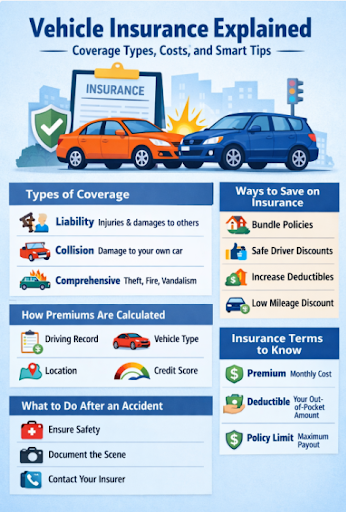
Vehicle insurance can feel confusing until you break it into plain pieces: what the policy is designed to cover, what it excludes, and how much risk you’re comfortable carrying yourself. Whether you drive daily for school and errands or only on weekends, the right coverage is less about “buying the most” and more about matching protection to real-life situations—accidents, repairs, medical bills, theft, and liability.
In this guide, you’ll get a straightforward look at how vehicle insurance works, the most common coverage options, the terms that actually matter, and practical tips to compare quotes without getting lost. If you want a quick primer on how policies are structured and what the main parts mean, this vehicle insurance introduction is a helpful place to start.
What Vehicle Insurance Is (and What It Isn’t)
At its core, vehicle insurance is a contract: you pay a premium, and the insurer agrees to pay for certain losses if a covered event happens. The key idea is “covered.” Insurance does not automatically pay for everything that can go wrong with a car. Coverage depends on:
- The types of coverage you selected (liability, collision, comprehensive, etc.).
- Your coverage limits (maximum the insurer will pay).
- Your deductible (what you pay before coverage applies in many cases).
- Your policy conditions and exclusions (situations the policy won’t cover).
Thinking clearly about insurance means separating two buckets: (1) damage you cause to others (liability), and (2) damage to your own vehicle (physical damage coverage like collision and comprehensive). Many people focus only on the price, but a cheaper policy can be expensive later if limits are too low or if important coverage is missing.
Common Types of Vehicle Insurance Coverage
Most policies are built by combining several coverage “modules.” Here are the ones you’ll see most often:
| Coverage Type | What It Typically Helps Pay For | When It Matters Most |
|---|---|---|
| Liability | Injuries and property damage you cause to others | At-fault accidents, lawsuits, expensive repairs on newer vehicles |
| Collision | Damage to your car after a crash (regardless of fault in many cases) | Accidents, single-car collisions, hitting objects |
| Comprehensive | Non-collision damage (theft, vandalism, weather events, animals) | High-theft areas, storm season, parking outside |
| Uninsured/Underinsured Motorist | Your costs if the other driver has little or no insurance | Accidents caused by uninsured drivers |
| Medical Payments / PIP (varies by state) | Medical expenses for you and passengers | Injuries after an accident, regardless of fault (depending on state rules) |
| Roadside / Rental Reimbursement (optional add-ons) | Towing, jump starts, rental car costs while repairs happen | Breakdowns, repair delays, daily commuting needs |
Coverage Limits and Deductibles: The Two Numbers That Change Everything
A policy’s value is often decided by limits and deductibles—not by the brand name. Limits are the maximum the insurer will pay; deductibles are what you pay first before the insurer contributes (commonly for collision and comprehensive).
- Higher limits generally mean better protection but higher premiums.
- Higher deductibles mean lower premiums, but greater out-of-pocket expenses when you make a claim.
A smart rule of thumb: choose deductibles you can realistically afford quickly. If a $1,000 deductible would cause major stress, picking it just to save a little per month can backfire.
How Insurers Calculate Your Price
Premiums are built from risk signals. Companies use different models, but these factors commonly influence pricing:
- Driving record: Tickets and at-fault accidents raise risk.
- Vehicle details: Repair cost, safety features, theft rates, and trim level matter.
- Location: Dense traffic, high theft, and weather risk can raise premiums.
- Annual mileage: More miles often mean more exposure to accidents.
- Driver profile: Age, experience, and household drivers can affect rating.
- Coverage selection: Adding collision/comprehensive increases premiums but can reduce financial risk.
Two people can get very different quotes for the same car in the same city. That’s why comparison shopping (the right way) is one of the most reliable ways to save.
How to Compare Quotes Without Getting Tricked by “Cheap”
Comparing quotes works best when you keep the coverage identical. Otherwise, you may be comparing apples to oranges. Use this checklist to keep your comparison fair:
- Match liability limits across all quotes.
- Match collision and comprehensive deductibles.
- Confirm uninsured/underinsured coverage is the same (if included).
- Check whether roadside/rental add-ons are included or excluded.
- Review the payment plan (monthly vs. paid-in-full discounts).
Once coverage matches, price differences become meaningful. Sometimes the “cheapest” quote is only cheaper because it has lower limits or removes physical damage coverage entirely.
Practical Ways to Lower Your Vehicle Insurance Cost
If your premium feels high, you don’t always need to sacrifice protection. Try these cost-control moves first:
- Bundle policies: Combining auto with renters/home can reduce total cost.
- Ask about discounts: Good student, safe driver, low mileage, and defensive driving discounts are common.
- Improve security: Anti-theft devices or garaging can help in some cases.
- Adjust deductibles carefully: Raise deductibles only if you can afford them.
- Remove unnecessary add-ons: If you rarely drive, some extras may not be worth it.
- Shop at renewal: Rates can change—review at least once a year.
When “Minimum Coverage” Can Be Risky
Many drivers carry only the minimum required by law to keep costs low. The problem is that minimum limits are designed to satisfy legal requirements, not necessarily to protect your finances during a serious incident. Repair bills on modern vehicles, medical care, and multi-car accidents can exceed low limits quickly.
If the cost of a realistic accident could exceed your limits, you may want to consider higher liability coverage. It often costs less than people expect to increase limits, especially compared to the financial damage of an uncovered balance.
Key Insurance Terms (Plain English)
| Term | What It Means |
|---|---|
| Premium | The amount you pay for the policy (monthly, semi-annual, or annual). |
| Deductible | Your share of a covered claim before the insurer pays (common for collision/comprehensive). |
| Limit | The maximum the insurer will pay for a covered loss under that coverage. |
| Exclusion | A situation the policy does not cover (listed in the policy language). |
| Claim | A request for coverage payment after an accident or loss. |
| Declarations Page | The summary page showing coverages, limits, deductibles, drivers, and vehicles. |
What to Do After an Accident
A calm, documented response helps protect you and can make the claims process smoother. Here’s a simple action list:
- Check for injuries and get medical help if needed.
- Move to a safe location if the vehicles can be moved and it’s safe to do so.
- Exchange information (names, plates, insurance info, contact details).
- Take photos of damage, the scene, and any relevant road signs or conditions.
- Report the accident to your insurer promptly and stick to the facts.
Even if the accident seems minor, documenting it is smart. Small bumps can lead to hidden damage or later disputes.
Quick Buyer’s Checklist: Choosing the Right Policy
If you want a simple way to narrow down your best options, use this checklist before you buy:
- Pick liability limits that protect your savings and income (not just the minimum).
- Choose deductibles you can pay without stress.
- Consider collision and comprehensive if your vehicle is hard to replace financially.
- Compare at least 3 quotes with identical coverage settings.
- Review the declarations page carefully before paying.
Conclusion
Vehicle insurance is easiest to understand when you focus on the parts that drive real outcomes: coverage types, limits, deductibles, and exclusions. “Cheap” coverage can be useful if it matches your situation, but it can also be risky if the limits are too low or key protection is missing. The smartest approach is to compare quotes with the same settings, choose deductibles you can afford, and pick liability limits that protect you from a worst-case day on the road.