Introduction
Market volatility is an inevitable part of investing, and 2026 is shaping up to be another year where investors may experience significant market swings. Factors such as inflation concerns, changing interest rates, geopolitical tensions, artificial intelligence (AI) valuations, evolving government policies, and global economic uncertainty can all influence stock prices. While these fluctuations can be unsettling, they also present opportunities for disciplined investors.
For small investors, protecting capital during periods of volatility is just as important as seeking growth. Successful investing is not about predicting every market movement but about building a resilient portfolio that can weather short-term turbulence while continuing to grow over the long term.
This guide explores practical strategies that small investors can use to protect their money during market volatility in 2026.
Understanding Market Volatility
Market volatility refers to the rate at which stock prices rise or fall over a given period. High volatility means prices move dramatically, while low volatility indicates more stable market conditions.
Several factors could contribute to volatility in 2026, including:
- Interest rate changes
- Inflation concerns
- Corporate earnings reports
- Geopolitical conflicts
- Technological disruption
- Economic slowdown fears
- Currency fluctuations
- Government regulations
Although volatility often creates anxiety, it is a normal feature of financial markets and should not automatically trigger panic.
Why Small Investors Are More Vulnerable
Unlike institutional investors, individual investors often have smaller portfolios and fewer resources to absorb large losses. Emotional decision-making can also lead to poor investment choices during uncertain times.
Common mistakes include:
- Selling during market crashes
- Buying after prices have already surged
- Investing without diversification
- Chasing speculative stocks
- Ignoring long-term investment goals
Understanding these risks is the first step toward building a more resilient investment strategy.
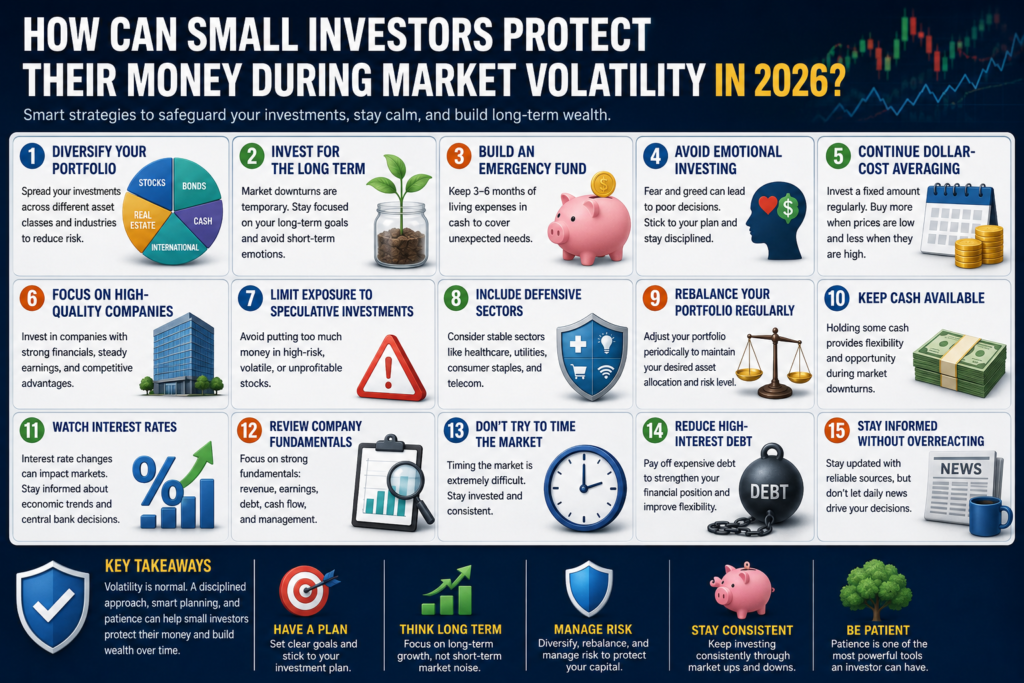
1. Diversify Your Portfolio
Diversification remains one of the most effective ways to reduce investment risk.
Rather than investing all your money in one company or sector, spread your investments across different asset classes and industries.
A diversified portfolio might include:
- Large-cap stocks
- Small-cap stocks
- International stocks
- Bonds
- Exchange-traded funds (ETFs)
- Dividend-paying companies
- Real estate investment trusts (REITs)
If one sector experiences losses, gains in another may help offset the decline.
2. Invest for the Long Term
Market downturns are temporary, but long-term growth has historically rewarded patient investors.
Instead of reacting to daily headlines, focus on your long-term financial objectives.
Long-term investing allows you to:
- Ride out short-term volatility
- Benefit from compound growth
- Reduce emotional decision-making
- Avoid excessive trading costs
Many of history’s strongest market recoveries have followed periods of sharp declines.
3. Build an Emergency Fund
Before investing aggressively, ensure you have sufficient emergency savings.
Financial experts commonly recommend keeping three to six months’ worth of living expenses in an easily accessible account.
An emergency fund helps prevent the need to sell investments during market downturns to cover unexpected expenses.
4. Avoid Emotional Investing
Fear and greed often drive poor investment decisions.
During volatile markets, investors may feel tempted to:
- Panic sell
- Buy into market hype
- Constantly check portfolio values
- Chase “hot” stocks
Successful investors develop a disciplined investment plan and stick with it despite temporary market fluctuations.
5. Continue Dollar-Cost Averaging
Dollar-cost averaging involves investing a fixed amount of money at regular intervals regardless of market conditions.
For example:
- Investing monthly
- Investing every paycheck
- Making automatic contributions
This strategy allows investors to purchase more shares when prices are low and fewer shares when prices are high.
Over time, this may lower the average purchase price of investments.
6. Focus on High-Quality Companies
Companies with strong financial health often perform better during uncertain economic periods.
Look for businesses with:
- Consistent earnings
- Strong cash flow
- Low debt
- Competitive advantages
- Reliable management
- Sustainable business models
These companies are generally better positioned to withstand economic slowdowns.
7. Limit Exposure to Speculative Investments
While emerging technologies like AI, blockchain, and biotechnology offer exciting opportunities, speculative investments often experience the largest price swings.
Avoid allocating too much of your portfolio to:
- Meme stocks
- Highly leveraged companies
- Unprofitable startups
- Extremely volatile sectors
Keeping speculative investments as a small percentage of your portfolio can help manage overall risk.
8. Include Defensive Sectors
Certain industries tend to remain relatively stable even during economic downturns.
Examples include:
- Healthcare
- Consumer staples
- Utilities
- Telecommunications
- Essential services
People continue purchasing necessities regardless of economic conditions, making these sectors less sensitive to market volatility.
9. Rebalance Your Portfolio Regularly
As markets move, your investment allocation may drift away from your original plan.
Rebalancing involves selling portions of investments that have grown significantly and increasing positions in underweighted assets.
Benefits include:
- Maintaining your target risk level
- Preventing overexposure to one sector
- Encouraging disciplined investing
Many investors review their portfolios every six to twelve months.
10. Keep Cash Available
Holding some cash can provide flexibility during volatile markets.
Cash reserves allow investors to:
- Take advantage of market declines
- Avoid selling investments during downturns
- Cover unexpected expenses
- Reduce overall portfolio volatility
However, holding too much cash for extended periods may reduce long-term investment returns due to inflation.
11. Watch Interest Rates
Interest rate decisions significantly influence financial markets.
Higher interest rates often affect:
- Technology stocks
- Growth companies
- Real estate
- Consumer spending
Investors should monitor central bank announcements and understand how changing rates may impact their portfolios.
12. Review Company Fundamentals
Instead of focusing solely on stock prices, evaluate the underlying business.
Important financial indicators include:
- Revenue growth
- Profit margins
- Debt levels
- Earnings consistency
- Free cash flow
Companies with strong fundamentals often recover more quickly after market declines.
13. Don’t Try to Time the Market
Even professional investors struggle to consistently predict market highs and lows.
Missing just a few of the market’s strongest recovery days can significantly reduce long-term returns.
Rather than attempting to buy at the lowest point or sell at the highest, maintain a consistent investment strategy.
14. Reduce High-Interest Debt
Protecting your finances extends beyond investing.
Paying off high-interest debt such as credit cards often provides a guaranteed financial benefit that may exceed potential investment returns.
Lower debt also improves financial flexibility during economic uncertainty.
15. Stay Informed Without Overreacting
Financial news changes daily.
While staying informed is important, constantly reacting to headlines can encourage emotional investing.
Instead:
- Follow reliable financial sources
- Review quarterly earnings
- Monitor economic trends
- Ignore short-term market noise
Focus on information that affects your long-term investment strategy.
Common Mistakes Small Investors Should Avoid
During volatile markets, many investors unintentionally increase their losses by making avoidable mistakes.
These include:
- Selling after markets decline
- Investing based on social media trends
- Ignoring diversification
- Using excessive leverage
- Frequently trading
- Chasing recent winners
- Forgetting long-term goals
Recognizing these behaviors can help investors make more rational decisions.
Building a Resilient Portfolio in 2026
A balanced portfolio should reflect your financial goals, time horizon, and risk tolerance.
An example allocation could include:
- 50–70% diversified stock funds
- 20–40% bonds or fixed-income investments
- 5–10% cash reserves
- Optional exposure to REITs, commodities, or international funds
The ideal mix depends on individual circumstances, but diversification remains the cornerstone of risk management.
The Importance of Patience
Volatile markets often test investors’ confidence.
History has shown that markets experience cycles of growth, corrections, bear markets, and recoveries. Investors who remain patient and avoid emotional reactions are often better positioned to benefit from long-term market appreciation.
Patience also allows compound returns to work over time, one of the most powerful drivers of wealth creation.
Final Thoughts
Market volatility in 2026 is likely to create both challenges and opportunities for small investors. Economic uncertainty, interest rate changes, inflation, geopolitical events, and rapidly evolving technologies may contribute to short-term market swings. However, these fluctuations do not have to derail long-term financial goals.
By diversifying investments, focusing on quality companies, maintaining an emergency fund, practicing dollar-cost averaging, avoiding emotional decisions, and reviewing portfolios regularly, small investors can better protect their money while remaining positioned for future growth.
The key to successful investing is not eliminating risk but managing it wisely. A disciplined, long-term approach, combined with sound financial planning, can help investors navigate uncertainty with greater confidence and resilience throughout 2026 and beyond.