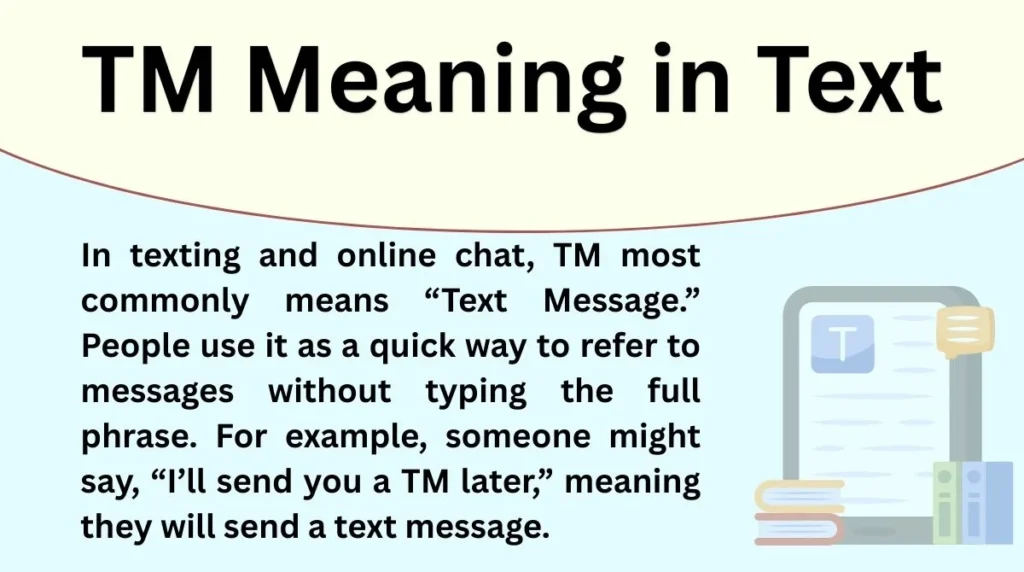
Tm meaning in text is one of those short online phrases that can be easy to misread at first glance. In many chats, it may point to a casual shorthand, while in a brand or product setting, it can also connect to the trademark symbol. The exact meaning depends on the sentence, the platform, and the intention behind the message. In text conversations, “TM” is commonly explained as “Trust Me,” “Text Message,” “Tomorrow,” or “Too Much,” while the trademark symbol is a separate meaning tied to branding and legal use.
Related keywords worth knowing here are texting abbreviation, chat shorthand, trademark symbol, message context, social media shorthand, online slang, and text messaging meaning.
What Tm Meaning in Text Usually Refers To
When people ask about tm meaning in text, they are usually trying to decode a short message or understand a social media phrase. In informal chats, the meaning is often attached to how the message sounds rather than the letters alone. A friend might use it as a quick shortcut for “Trust Me,” “Text Message,” “Tomorrow,” or “Too Much,” depending on what is being discussed. Some guides also describe “Text Me” as a common modern interpretation in casual messaging, especially when someone wants a reply or wants to continue the chat elsewhere.
That is why tm meaning in text should never be read too fast. Short forms are convenient, but they are not always universal. One sender may be talking about timing, another may be asking for a reply, and a third may be showing surprise or emphasis. A few letters can carry very different ideas, and only the surrounding words reveal the right one.
Why Context Matters So Much
The strongest rule for reading tm meaning in text is simple: context comes first. If the message says, “TM I will send it later,” the phrase may point to “Tomorrow.” If the message says, “TM, this is true,” it may mean “Trust Me.” If someone says, “Send me a TM,” they could be referring to a text message or asking you to text them. That flexibility is what makes the phrase useful, but it is also what makes it confusing.
Context matters because texting is fast, informal, and full of abbreviations that change from one group to another. A teenager, a coworker, and a brand account may all use the same letters differently. The safest habit is to read the full sentence, notice the tone, and think about the relationship between the people speaking. When in doubt, a short follow-up question is often better than assuming the wrong meaning.
Common Meanings People Attach to TM
The most common interpretations are easy to remember, and they appear often in online messaging guides. In casual texting, “TM” is frequently read as “Trust Me,” “Text Message,” “Tomorrow,” or “Too Much.” Some sources also describe “Text Me” as a popular modern use in chats and social apps. Meanwhile, outside casual chat, TM can still mean “Trademark,” especially in branding, product naming, and legal presentation.
A simple way to think about it is this: if the message feels personal and informal, tm meaning in text is usually a chat shorthand. If the message looks polished, branded, or business-related, the letters may be tied to a trademark or symbol instead. The same two letters can live in two very different worlds.
Tm Meaning in Text in Everyday Chats
In everyday conversation, tm meaning in text is often used to save time. People like short forms because they are quick to type and easy to send during a busy day. A person might write “TM” when they want to reassure someone, set a timeline, or keep the message light and informal. This is especially common in fast-moving chats where people already understand one another’s style.
The key is not to memorize one fixed meaning and force it into every message. A short message like “TM later” sounds very different from “That is TM.” The first might point to a time reference, while the second might be a reaction. Good readers pay attention to the whole sentence instead of the letters alone. That habit prevents confusion and makes replies smoother.
Tm Meaning in Text and the Trademark Symbol
There is another major meaning attached to the phrase tm meaning in text, and it comes from branding. The trademark symbol “™” is used to show that a word, phrase, logo, or design is being claimed as a trademark. Wikipedia describes the trademark symbol as a sign used to indicate an unregistered trademark, which is different from the registered trademark symbol “®.”
This is important because people sometimes see “TM” in a post or product name and assume it is the same as casual texting slang. It is not always the same thing. In a brand context, it can be a visual mark that signals ownership or brand identity, while in chat it can simply be shorthand. So tm meaning in text can point to language, but it can also point to a symbol used in business communication.
How to Tell the Difference Quickly
A practical way to decode tm meaning in text is to ask three questions. First, is the message casual or official? Second, is the sentence about feelings, timing, or a reply? Third, does the message look like it comes from a brand, store, or product page? If the answer leans toward casual conversation, the meaning is probably one of the common texting forms. If it leans toward branding, the trademark meaning becomes more likely.
Here is the easiest habit: read the sentence around the letters, not just the letters themselves. A short phrase can be playful, serious, or professional depending on the setting. That is why people often misunderstand abbreviations when they are new to texting or when they switch between social media and business communication. The surrounding words are the real guide.
Examples That Make the Meaning Clear
A few simple examples help show how tm meaning in text changes with the sentence.
“TM, I will call you later.”
This sounds like “Tomorrow” or possibly “Text Me,” depending on the conversation.
“That was TM funny.”
This can suggest “Too Much,” meaning the situation was excessive or over the top.
“TM, trust me on this one.”
Here the phrase clearly works as “Trust Me.”
“Use the brand name with TM.”
This points to the trademark symbol or the branding idea, not chat slang.
These examples show why one fixed answer is not always enough. The best reading comes from tone, setting, and the purpose of the message.
Tm Meaning in Text on Social Media
On social media, tm meaning in text can move even faster because posts are short and people often rely on shorthand. A caption, comment, or direct message may use “TM” as part of an informal style that feels quick and familiar. That same short form can also appear in product posts, page names, or account branding, where it may be linked to trademark usage instead. Social media is where the two meanings can sit side by side without warning.
That is why readers should not rush. A creator might use “TM” as a casual phrase in a reply, while a company might use the same letters to mark a product claim. The meaning is shaped by the account, the audience, and the purpose of the post. When a platform encourages fast reading, careful reading becomes even more valuable.
Tm Meaning in Text in Brand and Product Names
Brand pages often use TM differently from ordinary chats. In this setting, the letters are not meant as slang. They are part of identity, ownership, and presentation. A company may place the trademark symbol near a logo or product name to show that it is claiming a mark. That is why tm meaning in text can shift from “chat shorthand” to “brand notation” without warning.
BusinessToMark has a useful article on brand name normalization and trademark symbols, which connects closely to this usage. It explains why consistent spelling, capitalization, and symbol use matter in branding.
For readers who see TM in a product name, the safest approach is to read it as a branding signal unless the surrounding message clearly shows a casual texting meaning. That habit avoids confusion in shopping pages, brand bios, and promotional posts.
A Simple Way to Remember the Difference
You can keep tm meaning in text straight by separating it into two lanes. One lane is informal chat, where the letters often mean “Trust Me,” “Text Message,” “Tomorrow,” or “Too Much.” The other lane is branding, where TM points to trademark use and visual identity. Once you know which lane you are in, the meaning becomes much easier to spot.
This is also why strong digital reading habits matter. Online language moves quickly, and abbreviations often shift meaning depending on platform and audience. A phrase that looks ordinary on a messaging app may carry a different role on a business page. The more you look at tone and setting, the less likely you are to misread the message.
When TM Can Be Misread
Tm meaning in text can be misread when the message is very short, when punctuation is missing, or when the sender assumes the reader already knows the code. That is common in busy chats, group messages, and social updates. A single abbreviation can feel obvious to the sender and unclear to the reader. That gap is where confusion starts.
This is one reason many people prefer to write the full phrase when the message matters. Short forms are fine for quick talk, but clarity is more important when timing, instructions, or reputation are involved. The smaller the message, the more room there is for misunderstanding. That is especially true when someone is reading the message out of context.
Writing Clearly Without Losing the Casual Tone
You do not have to remove personality from your message just to be clear. Instead of overusing shorthand, you can keep your tone friendly and still write in a way that is easy to follow. If you mean “Tomorrow,” just write “tomorrow.” If you mean “Trust Me,” just write “trust me.” If you mean a trademark, use the symbol properly in the right place. Clear writing is still simple writing.
This approach is especially helpful when you speak to different audiences. Friends may understand shorthand instantly, but teachers, clients, readers, and customers may not. Full words reduce the chance of confusion and make your message look thoughtful. In many situations, that is worth the extra few letters.
Related Resources Worth Reading
These BusinessToMark pages connect well with the topic of symbols, wording, and online communication:
What Are Brand Name Normalization Rules?
How to Fix WiFi Not Working on My Phone But Working on Other Devices?
A Complete Guide to mysignins.microsoft.com security-info
The first one is the closest match because it explains trademark presentation and consistent brand wording. The other two are useful for general digital communication, device use, and text-message-based verification flows.
Tm Meaning in Text in Real-Life Use
In real life, tm meaning in text is best understood as a flexible expression rather than a single fixed definition. That is the reason people get different answers when they ask the question in different settings. A teenager replying in a group chat, a brand manager posting product names, and a business owner writing a label are not using the letters in the same way. The reader must match the meaning to the situation.
The safest habit is simple: read the whole sentence, check the tone, and notice whether the message is casual or official. If it feels like a friendly conversation, the meaning is likely one of the common chat forms. If it looks branded, the trademark meaning becomes more likely. That small pause before reacting can save a lot of confusion.
Common Mistakes People Make
One common mistake is assuming tm meaning in text always has just one answer. It does not. Another mistake is ignoring the brand context and reading every TM as a chat abbreviation. That can lead to a wrong reply, a missed detail, or a confused conversation. A third mistake is trying to interpret the letters without looking at the platform. WhatsApp, Instagram, email, and business pages do not use shorthand in exactly the same way.
Another error is overexplaining the abbreviation when the message is already clear. In some cases, the surrounding sentence gives enough information. The better approach is to stay alert, not anxious. You only need enough context to understand the message correctly.
Final Thoughts
Tm meaning in text is small in size but big in flexibility. In casual chats, it can stand for common phrases like “Trust Me,” “Text Message,” “Tomorrow,” or “Too Much.” In branding, it may point to the trademark symbol and the idea of ownership in a name or design. That is why the same two letters can look simple and still carry two different worlds of meaning.
The easiest way to read tm meaning in text is to stay aware of context. Check the tone, the sender, the platform, and the purpose of the message. Once you do that, the meaning usually becomes clear very quickly. In online communication, a little attention goes a long way.
For a quick background on the trademark symbol, see this reference: Wikipedia: Trademark symbol.