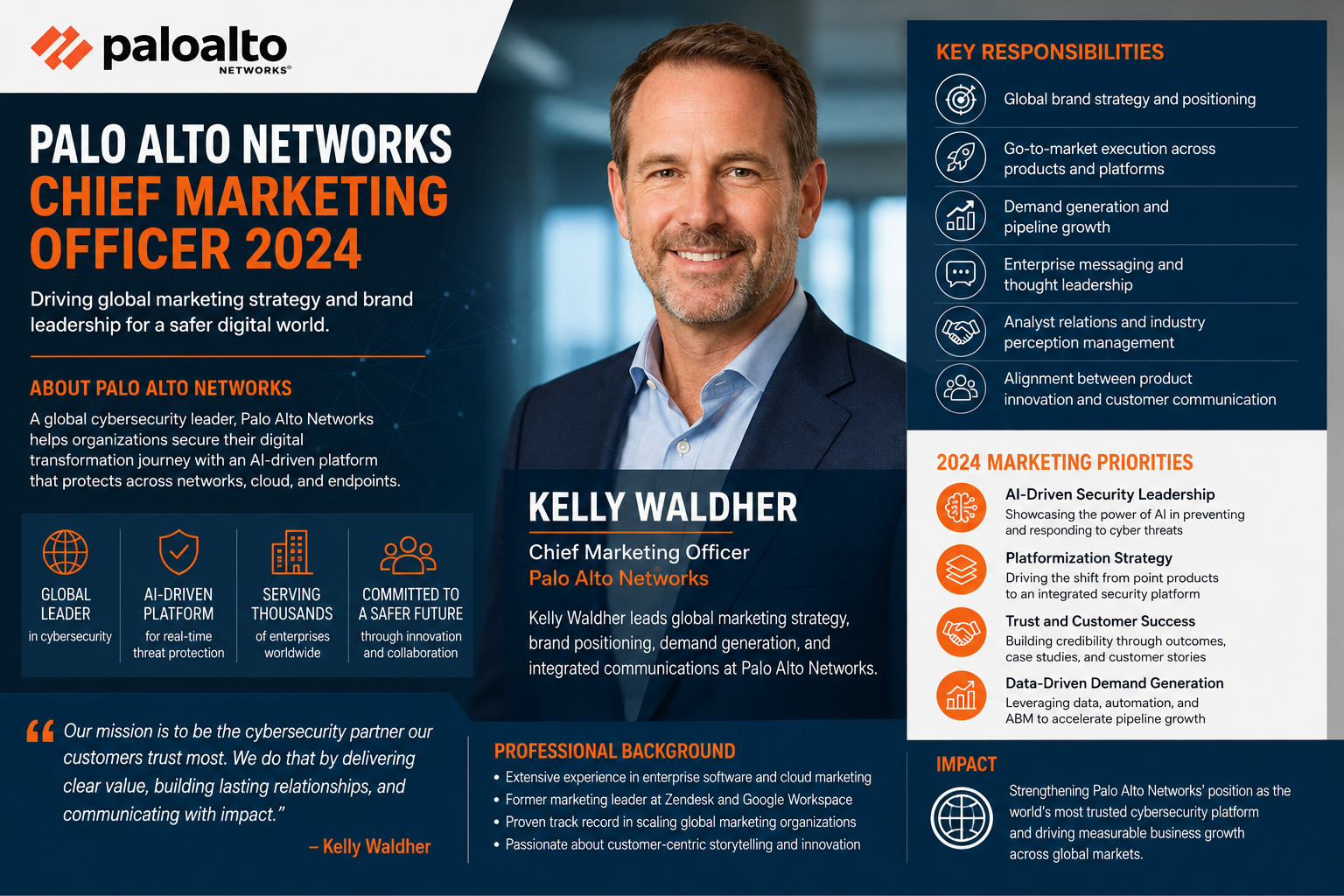
The role of the Chief Marketing Officer (CMO) at Palo Alto Networks in 2024 sits at the intersection of cybersecurity innovation, enterprise trust-building, and global go-to-market strategy. As one of the world’s leading cybersecurity firms, Palo Alto Networks relies heavily on marketing leadership to translate highly complex technical capabilities—such as AI-driven threat detection, cloud security, and platform-based protection—into clear, compelling narratives for businesses worldwide.
In 2024, the CMO role is widely reported to be held by Kelly Waldher, who leads global marketing strategy, brand positioning, demand generation, and integrated communications for the company.
This article explores the responsibilities, background, strategic direction, and broader impact of the Palo Alto Networks CMO in 2024, along with how the role shapes the company’s position in the global cybersecurity market.
The Role of the CMO at Palo Alto Networks in 2024
At a high level, the CMO at Palo Alto Networks is responsible for shaping how the world understands the company. Unlike consumer brands, cybersecurity marketing is not about emotional appeal or lifestyle positioning—it is about trust, clarity, and proof of capability.
The CMO’s responsibilities typically include:
- Global brand strategy and positioning
- Go-to-market (GTM) execution across product lines
- Demand generation and pipeline influence
- Enterprise messaging and thought leadership
- Analyst relations and industry perception management
- Alignment between product innovation and customer communication
In a sector where breaches and cyber threats evolve daily, marketing leadership must ensure messaging remains both technically accurate and strategically compelling.
Palo Alto Networks: Why Marketing Leadership Matters
Palo Alto Networks operates in a highly competitive cybersecurity landscape that includes cloud security, endpoint protection, and network defense platforms. The company’s portfolio spans multiple domains, meaning customers often face complexity when evaluating solutions.
This is where marketing leadership becomes critical:
1. Translating Complexity into Clarity
Cybersecurity platforms involve AI models, threat intelligence systems, and cloud-native architecture. The CMO’s role is to simplify this complexity for enterprise buyers.
2. Building Trust in a Risk-Driven Industry
Security vendors are judged on credibility. Marketing must reinforce reliability, scale, and resilience.
3. Positioning Against Strong Competitors
The cybersecurity industry includes major players, requiring constant differentiation through messaging and brand authority.
Leadership in 2024: Kelly Waldher’s Role
Multiple industry summaries identify Kelly Waldher as the Chief Marketing Officer and Executive Vice President of Marketing for Palo Alto Networks in 2024.
His leadership focuses on scaling marketing operations globally while strengthening the company’s identity as a platform-driven cybersecurity leader.
Key responsibilities associated with his role include:
- Leading global marketing teams across regions
- Aligning marketing with product and sales strategy
- Driving platform-centric messaging (rather than product silos)
- Expanding enterprise awareness of AI-driven cybersecurity solutions
- Supporting long-term customer acquisition strategies
This reflects a broader industry shift: cybersecurity companies are no longer selling standalone tools, but integrated security platforms.
Professional Background and Career Path
Kelly Waldher’s background reflects extensive experience in enterprise software and cloud marketing. According to industry profiles, his career includes leadership roles at major technology firms:
- Marketing leadership at global enterprise SaaS companies
- Experience in cloud productivity ecosystems
- Senior executive roles in demand generation and product marketing
- Prior leadership roles at companies such as Zendesk and Google Workspace
- Long tenure in enterprise-scale marketing transformation initiatives
This type of background is particularly valuable in cybersecurity, where buyers are typically CIOs, CISOs, and large enterprise decision-makers.
Strategic Marketing Priorities in 2024
The 2024 marketing strategy for Palo Alto Networks reflects several major industry trends.
1. AI-Driven Security Messaging
One of the dominant themes in cybersecurity is the integration of artificial intelligence into threat detection and response systems. Marketing efforts focus on:
- Explaining AI-powered security capabilities
- Highlighting automation in threat response
- Positioning the company as a leader in “AI-first security”
2. Platformization Over Product Marketing
Instead of promoting individual tools, Palo Alto Networks increasingly emphasizes a platform narrative:
- Integrated security ecosystem
- Unified visibility across networks, cloud, and endpoints
- Reduced operational complexity for enterprise customers
3. Trust-Based Branding
In cybersecurity, trust is a core marketing asset. Campaigns focus on:
- Customer case studies
- Enterprise resilience stories
- Industry analyst validation
- Security outcomes rather than feature lists
4. Data-Driven Demand Generation
Modern enterprise marketing relies heavily on analytics:
- Pipeline tracking
- Customer journey optimization
- Account-based marketing (ABM) strategies
- Personalized enterprise outreach
Challenges Facing the CMO Role
The CMO at a company like Palo Alto Networks operates in a challenging environment.
1. Technical Complexity
Cybersecurity is inherently difficult to explain to non-technical stakeholders.
2. Rapidly Evolving Threat Landscape
Marketing messaging must adapt quickly to emerging threats such as ransomware, AI-based attacks, and cloud vulnerabilities.
3. Global Audience Diversity
The company serves enterprises across industries and regions, requiring localized messaging strategies.
4. Competitive Pressure
The cybersecurity market is crowded, with constant innovation from competitors requiring continuous repositioning.
The Impact of Marketing on Business Growth
The CMO role is directly tied to revenue performance in enterprise software companies. At Palo Alto Networks, marketing supports:
- Enterprise pipeline growth
- Brand differentiation in competitive deals
- Product adoption across global markets
- Long-term customer retention and expansion
Strong marketing leadership ensures that technical innovation translates into commercial success.
The Evolution of Cybersecurity Marketing
The 2024 CMO role reflects a broader transformation in cybersecurity marketing:
- From product-centric to platform-centric messaging
- From technical jargon to business outcome storytelling
- From regional campaigns to global integrated strategies
- From static messaging to AI-enhanced personalization
This evolution reflects how cybersecurity has become a board-level concern in enterprises worldwide.
Leadership Alignment with Corporate Strategy
Marketing leadership at Palo Alto Networks is closely aligned with executive strategy led by CEO Nikesh Arora and the broader leadership team. The goal is to position the company not just as a cybersecurity vendor, but as a global platform for digital trust and security transformation.
This alignment ensures that marketing is not a downstream function, but a core driver of business strategy.
Conclusion
The Chief Marketing Officer role at Palo Alto Networks in 2024 represents far more than traditional marketing leadership. It is a strategic function that connects technology innovation with global enterprise demand.
With Kelly Waldher widely recognized as the CMO during this period, the company’s marketing direction focuses on AI-driven messaging, platform positioning, and trust-based enterprise branding.
In an era where cybersecurity is critical to global business continuity, the CMO plays a central role in shaping how enterprises understand risk, evaluate solutions, and ultimately choose their security partners.
The result is a marketing function that is deeply integrated with product innovation, sales execution, and long-term strategic growth—making it one of the most influential executive roles within the cybersecurity industry today.